Dental implants have gone from uncommon to mainstream fast. In a nationally representative U.S. analysis, implant use among adults with missing teeth rose from 0.7% in 1999 to 2000 to 5.7% in 2015 to 2016, and that shift happened for a simple reason: dental implants can replace a missing tooth in a way that feels stable, functional, and natural. A dental implant is a small post, usually made of titanium, placed in your jawbone to act like an artificial tooth root, then topped with a crown, bridge, or denture.
What dental implants are and why so many people choose them
That growth in implant use tells you something important. Missing teeth are not just a cosmetic issue, and more people now see implants as a long-term way to restore chewing, speech, and daily comfort, not just appearance.
In plain English, an implant replaces the root first and the visible tooth second. That matters because a root-anchored replacement stays in place differently than a removable option. What this means in practice: if you want something that helps you bite, chew, and smile with more confidence, an implant is worth asking about, especially if the alternative is a loose denture or a bridge that would involve neighboring teeth.
A simple rule helps here. If a missing or failing tooth is affecting how you eat, how your bite feels, or how much you trust that side of your mouth, bring up implants during your next exam.
The parts of a dental implant
A dental implant has three main parts. The implant post sits in the bone. The abutment connects the post to the final tooth. The restoration is the part you see, usually a crown for one tooth, a bridge for several teeth, or a denture for a full arch.
Picture it as a foundation, connector, and finished surface. The post provides support, the abutment creates the attachment point, and the crown or denture restores function and appearance. Once you see the full system, implants sound a lot less mysterious.
How implants compare with bridges and dentures
A bridge fills a gap by attaching to neighboring teeth. A denture replaces several or all teeth and may rest on the gums. An implant anchors into bone, which is why it often feels more secure.
That said, implants are not automatically the right answer for every situation. Bridges can be faster when the nearby teeth already need crowns. Dentures can cost less upfront and may still be the most practical option in complex cases. But if stability, chewing power, and a more fixed feel matter most to you, implants usually have the edge. The tradeoff is time, planning, and often higher cost.
How dental implants work inside your jaw
A 2026 community-practice research summary reported 5-year survival rates for osseointegrated implants in the 90% to 96.2% range. That success starts with one biological process: osseointegration.
Osseointegration means the implant bonds with your jawbone over time. Bone grows tightly around the implant surface, so the post becomes stable enough to function like an artificial root. It is not glued in. Your body actually locks it into place.
What this means in practice is straightforward. Healing matters because that bond takes time. Stability matters because a well-integrated implant usually feels firmer than a removable replacement. Long-term function depends less on luck and more on bone support, healthy gums, and a well-planned bite. If you are missing a tooth, the move that works is to ask for an evaluation of bone support before waiting too long.
Why bone quality matters
Bone is the implant’s foundation. If bone is too thin, too soft, or has shrunk after tooth loss, the implant may need a different position, a different size, or added grafting first.
After a tooth is lost, the jaw in that area no longer gets the same stimulation from chewing through a natural root. Over time, the bone can shrink. Sometimes that change is mild. Sometimes it changes the whole plan. Here’s how to use that information: if you have had a missing tooth for years, do not assume the area is unchanged just because it looks fine from the outside.
Why some implants need more healing time than others
A 2025 large-scale study of augmented implant sites found that immediate placement had a higher failure rate than delayed placement, even though overall outcomes were still strong. Faster treatment can be appropriate, but it has to fit the situation.
Immediate placement means the implant goes in right after a tooth is removed. Immediate load means a temporary tooth is attached very soon after placement. Delayed treatment means you heal first, then have the implant placed later, or let the implant heal before attaching biting force. The simplest version of this: same-day treatment can be real, but it is not the safest shortcut for every mouth.
Who is a good candidate for dental implants
A multicenter review found success rates stayed high in both healthy and systemically compromised patients, 96.76% versus 97.60%, with similarly strong 11-year survival. That matters because many people rule themselves out too early.
Good implant candidacy depends on a few things: healthy gums or gum disease under control, enough bone volume, manageable bite forces, solid home care, and medical conditions that are stable rather than ignored. Smoking, poorly controlled diabetes, and teeth grinding can raise risk, but none automatically means no.
What this means in practice: do not assume age, anxiety, or a health condition makes you a bad candidate. A better move is to schedule an implant consult before deciding it is off the table.
Signs you may be ready for an implant evaluation
You are likely ready for an evaluation if you have one missing tooth, several missing teeth, a denture that slips, a cracked tooth that cannot be predictably saved, or a strong preference for a fixed replacement.
Another common reason is frustration. If you keep chewing on one side, avoiding certain foods, or hiding a gap in photos, that is enough reason to have the conversation.
When extra planning is needed
Some situations need a closer workup. Active gum disease, heavy grinding, low bone volume, implants near the sinus area, or a long delay after tooth loss can all change timing and technique.
None of that is bad news by itself. It just means planning becomes more detailed. Digital imaging, bite analysis, and sometimes staged treatment help reduce surprises later.
Types of dental implants and materials
Dental implants come in a few forms, but most patients are really choosing based on the problem being solved, not the engineering label. Endosteal implants are the standard type placed in bone. Mini implants are narrower and may help in select cases, especially when space is limited or denture retention is the main goal. Implant-supported bridges replace multiple missing teeth without placing one implant for every tooth. Implant-supported dentures anchor a removable or fixed full-arch option.
Material matters too. According to 2025 market data, titanium held 85.53% of the implant market, which lines up with its long track record and broad clinical use. What this means in practice: titanium is still the default for a reason, while newer or less common materials are usually chosen for specific preferences rather than because titanium stopped working.
Titanium vs zirconia
Titanium is the most common and best-studied implant material. It is strong, widely used, and supported by decades of clinical evidence. For most people, that long track record is a real advantage.
Zirconia is a tooth-colored ceramic alternative that some people ask about for esthetic reasons, especially if gum tissue is thin and there is concern about gray show-through. It can be a reasonable option, but it is not automatically better. Here’s the practical takeaway: if material choice matters to you, ask how it affects strength, design flexibility, and long-term evidence in your specific case.
Single-tooth, multiple-tooth, and full-arch options
For one missing tooth, the usual solution is one implant with one crown. For several missing teeth in a row, an implant-supported bridge may replace the section without using one implant per tooth. For full-arch tooth loss, implants can support either a snap-in overdenture or a fixed full-arch prosthesis.
The right type depends less on trends and more on anatomy, budget, and what daily life needs to feel like. If you want the most fixed option possible, full-arch implants may appeal to you. If easier cleaning and lower cost matter more, an implant-supported overdenture may be the better fit.
What to expect before, during, and after the procedure
A calm, step-by-step process makes implant treatment much easier to picture, especially if dental visits already make you nervous. Most implant cases move through consultation, imaging, planning, surgery, healing, and final restoration, not all in one appointment.
The catch is that “done” often happens in phases. A temporary tooth may come first. The final crown or denture may come months later. That is normal, not a sign that something is going wrong. Before your consult, write down your top three questions so the visit feels less overwhelming and more useful.
The evaluation and planning visit
Planning starts with an exam, health history, and imaging. That may include digital X-rays and often 3-D scans to measure bone, locate nerves or sinus spaces, and decide where an implant can go safely.
Digital dentistry has made this process easier to understand. Scans, guided planning, and CAD/CAM workflows can improve precision and reduce surprises. For you, that usually means a clearer explanation of timing, cost, and what happens first.
Implant placement surgery
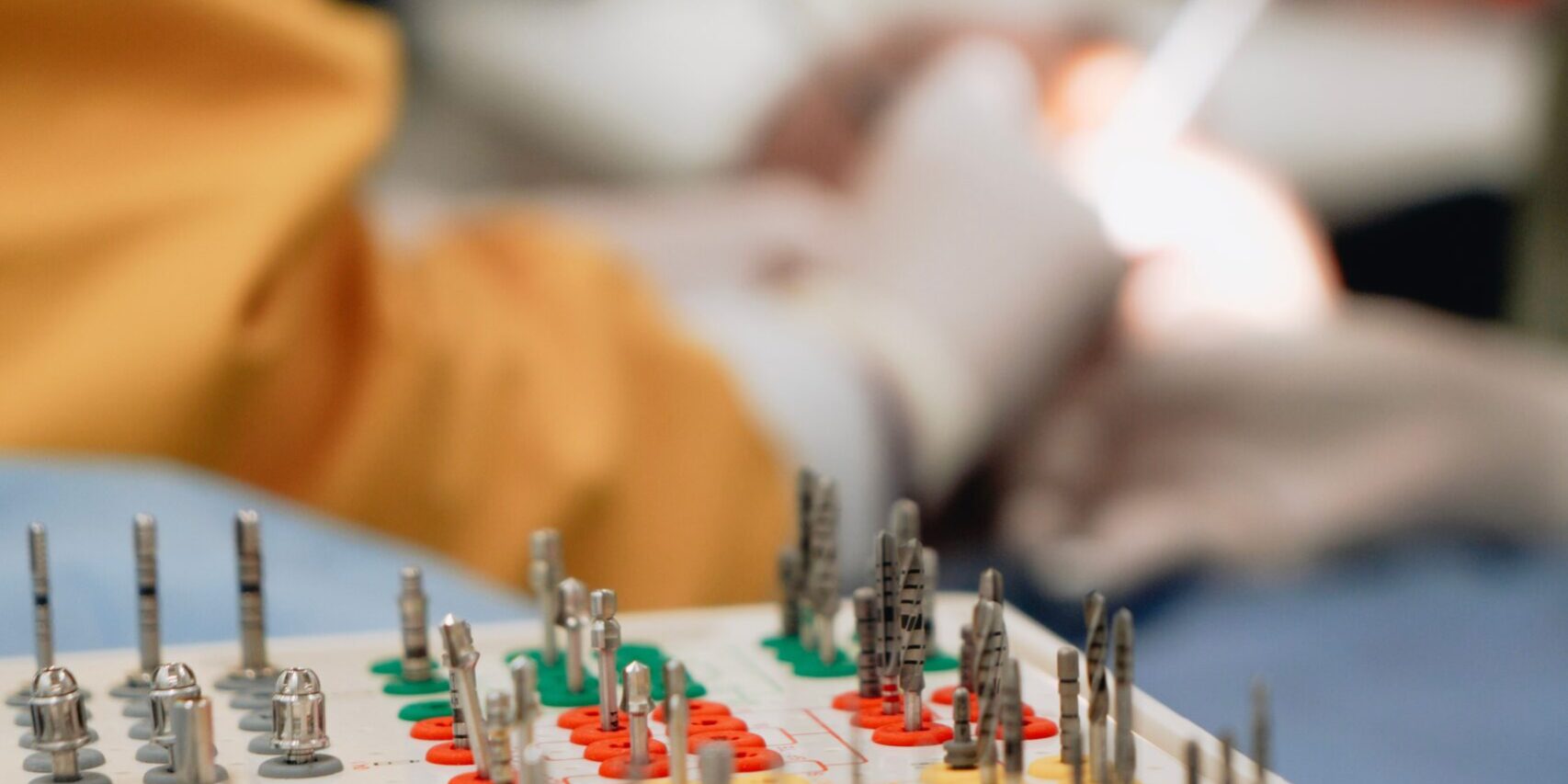
On surgery day, the area is numbed thoroughly. If sedation is part of the plan, you may feel relaxed or sleepy rather than fully aware of each step. The visit length depends on how many implants are placed and whether extra treatment, such as grafting or an extraction, happens at the same time.
Right after surgery, some soreness, swelling, or tenderness is normal. Most discomfort is manageable with routine aftercare. Honestly, many people expect something much harsher than what they actually feel.
Healing, osseointegration, and the final tooth
Healing after implant placement usually takes weeks to months, depending on the case. During that time, the implant bonds with bone. In some situations, a temporary tooth is worn while healing happens underneath.
Once the implant is stable, the final phase begins. An abutment may be placed if it was not attached earlier, then impressions or digital scans are used to make the final crown, bridge, or denture. Finished treatment often unfolds in stages, and that pacing is part of what protects the result.
When bone grafting or other preparatory treatment is needed
In a study of 158,824 implants, implants placed with simultaneous bone augmentation had a 97.83% success rate. That is reassuring because bone grafting is common, and it does not mean something has gone wrong.
Bone grafting simply means rebuilding or preserving bone where support is limited. Socket preservation helps maintain bone after an extraction. Ridge grafting adds width or height where the jaw has shrunk. A sinus lift creates room for implants in the upper back jaw where the sinus sits close to the bone. What this means in practice: if a graft is recommended, hear it as a planning tool, not a setback. Ask whether preserving bone now could make treatment simpler later.
Why bone loss happens after a tooth is lost
Without a natural tooth root in place, the jawbone in that area gradually loses stimulation. Over time, the ridge can become narrower and shorter.
That change can affect both appearance and implant options. Early planning helps because it gives you more choices before the bone shrinks further.
Common prep treatments before implants
Prep treatment may include extracting a non-restorable tooth, treating gum disease, placing a bone graft, or using a temporary tooth while the site heals. Sometimes the prep phase is short. Sometimes it is the main part of the timeline.
The move that works is patience. Building a healthier foundation usually improves the odds that the implant will last.
Benefits, risks, and how to improve your chances of success
Long-term implant outcomes are generally strong, but balance matters. A 2026 research summary noted survival rates alone do not capture every complication, including gum inflammation around implants and prosthetic issues over time.
The benefits are real: better chewing, clearer speech for some people, more stability than removable options, support for the jaw in the treated area, and often a big jump in confidence. Risks are real too: infection, failed integration, healing problems, and in certain parts of the mouth, nerve or sinus complications. Smoking, poor diabetes control, low bone volume, and rushed case timing can raise those risks.
What this means in practice is simple. Success is planning plus habits. If you smoke, discuss quitting support before treatment, because few changes improve implant odds more directly.
Common benefits you may notice day to day
The biggest day-to-day benefit is usually trust. You can bite into food with less worry about movement, pressure spots, or a gap shifting your chewing pattern.
Many people also notice that the implant-supported tooth feels more like part of the mouth and less like a device. That natural feel is a major reason implants stay popular.
Risk factors that matter most
Timing matters because fresh extraction sites and immediate treatment can be appropriate, but not every site heals predictably. Bone volume matters because the implant needs enough support from the start. Gum health and oral hygiene matter because inflamed tissue around implants can turn into bigger problems later.
Follow-up matters too. Small bite issues, loosened components, or early gum irritation are easier to fix when caught early.
Cost, insurance, and why implants are becoming more common
Dental implants are more common partly because the technology is better and partly because demand is rising. Mordor Intelligence projects the global market to grow from USD 5.75 billion in 2026 to USD 8.37 billion by 2031. Aging populations, improved digital workflows, and broader reimbursement in some countries are all pushing implants toward routine care rather than niche treatment.
For your situation, the bigger point is that implant cost is not one number. Price depends on how many teeth are involved, whether extractions or grafting are needed, what restoration is used, and how complex the planning is. If full treatment at once feels out of reach, ask for a phased plan that handles the most urgent need first.
What affects the total cost
Total cost can include the exam, imaging, extraction, grafting, implant placement, abutment, final crown or denture, and maintenance visits. A straightforward single implant usually costs less than a case involving bone rebuilding or full-arch reconstruction.
Materials and lab work also affect price. So does complexity. A back tooth with plenty of bone is simply different from a front tooth in a thin esthetic zone.
How digital dentistry is changing the experience
Intraoral scanning, guided surgery, CAD/CAM design, and 3-D printing are changing implant care in practical ways. Fewer messy impressions. Better communication about what is being planned. In some cases, fewer visits or a faster turnaround for final teeth.
AI is starting to help with planning and follow-up too, though it remains a tool, not the decision-maker. For you, the benefit is mainly clarity and precision.
How to care for dental implants for the long term
Professional guidance and long-term data point in the same direction: implants last longer when gum health and maintenance stay on track. An implant cannot get a cavity, but the tissue and bone around it can still become inflamed.
Daily care is simpler than people expect. Brush thoroughly, clean between teeth or around the implant with the tools recommended for your mouth, and keep regular checkups so small problems do not turn into bigger ones. This week, book a preventive visit or ask for a hands-on demo of how to clean around an existing implant properly.
Daily care at home
Treat an implant like a tooth that still needs attention at the gumline. Brush twice a day, clean between teeth, and pay special attention where the implant crown meets the gums.
Consistency matters more than fancy products. Good technique beats a crowded bathroom drawer.
Follow-up visits and warning signs to watch for
Regular follow-up visits help monitor gum health, bone levels, bite forces, and how the restoration is holding up. That is especially useful because some implant problems start quietly.
Do not ignore bleeding, swelling, looseness, pain when chewing, bad taste, or a bite that suddenly feels off. Those signs do not always mean failure, but they do mean it is time for a prompt exam.
Frequently asked questions
How long do dental implants last?
Dental implants can last many years and often decades when planning, healing, and maintenance go well. The implant itself may outlast the crown attached to it, since crowns can wear or need replacement before the implant does.
Does getting a dental implant hurt?
During the procedure, numbness keeps the area comfortable. Afterward, soreness and swelling are common, but many people describe the recovery as easier than expected, especially compared with the anxiety beforehand.
How long does the full dental implant process take?
Some cases move quickly, but many take several months from evaluation to final crown. The timeline depends on healing, bone quality, grafting, and whether a tooth needs to be removed first.
Can you get dental implants if you have gum disease or diabetes?
Possibly, yes. Gum disease usually needs treatment first, and diabetes should be well controlled. A medical condition does not automatically rule you out, but it does make planning and follow-up more important.
Are dental implants better than dentures?
For stability and a more fixed feel, implants are often better. But dentures can still be the right solution when cost, anatomy, or medical factors make a removable option more practical.
What to do before making the decision
The smartest next step is not to decide from online reading alone. Write down your top three concerns, ask for an implant evaluation with imaging, and find out what your bone, gums, bite, and budget actually allow right now. Once you know that, the decision usually gets much clearer.