A 2018 Journal of Dental Research analysis found that dental implant use in U.S. adults missing teeth rose from 0.7% to 5.7% over the study period. Full arch dental implants sit at the advanced end of that shift: a fixed solution for replacing all teeth in your upper arch, lower arch, or both, and a very different experience from living with removable dentures.
What full-arch dental implants are
According to WHO data cited in market research, complete tooth loss affects about 7% of adults over 20 and 23% of adults over 60. That matters because full-arch treatment exists for a specific problem: you need every tooth in one arch replaced, and you want a fixed set of teeth anchored by implants instead of a denture that comes out at night.
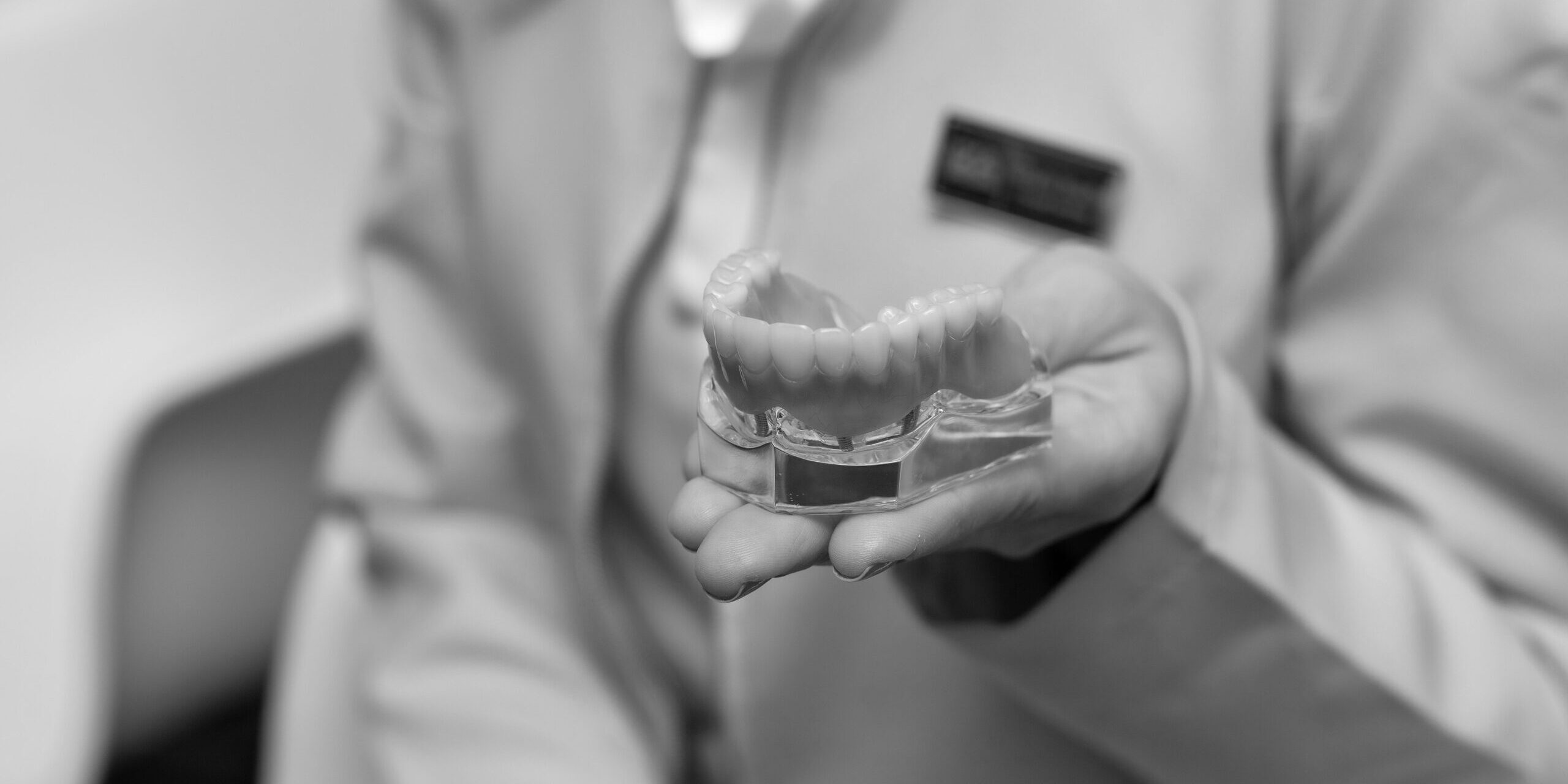
In plain English, full-arch dental implants are an implant-supported replacement for a whole row of teeth. Small titanium posts are placed in your jawbone, then a full set of replacement teeth is attached to them. Think of it like building a bridge on anchored supports instead of resting it on the gums alone.
You will also see overlapping terms online: All-on-4, full mouth implants, fixed full arch implants, and implant-supported full-arch prosthesis. Some describe a specific treatment design. Some describe the broader category. The core idea stays the same: implants support an entire arch of teeth.
Full-arch implants vs. traditional dentures
A 2024 systematic review of implant-supported full-arch fixed prostheses in the edentulous maxilla found high satisfaction, better quality of life, and mild postoperative symptoms. What this means in practice is simple: fixed teeth feel more secure.
Traditional dentures sit on the gums and can shift when you chew or speak. Full-arch implants stay anchored. That changes meals, because tougher foods feel manageable again. It changes speech, because you are not bracing against movement. It changes comfort, because there is no adhesive routine and far less day-to-day frustration.
If you are actively comparing both options, it helps to understand how fixed teeth and removable dentures feel over time. That difference is usually what drives the decision.
What “all-on-4” and similar terms mean
A systematic review of the all-on-four concept published in 2017 screened 728 articles and found strong short- to midterm predictability for that design. The practical takeaway is that All-on-4 is a real treatment concept, but it is not the only one.
“All-on-4” means one full arch is supported by four implants. Some cases use four. Some use five or six. The number is based on bone support, bite forces, arch shape, and the design needed for long-term function. The move that works is to stop focusing on the brand-like phrase and focus on whether your arch needs four, five, or six anchors to be stable.
How full-arch dental implants work
Grand View Research reports that digital implant planning and guided surgery improve accuracy and efficiency in implant treatment. For full-arch cases, that matters more than most people realize, because precise placement shapes everything that comes after.
The simplest version of this is straightforward. Implants are placed in the jawbone where tooth roots used to be. As healing happens, the bone locks around the implants. After that, a full set of replacement teeth is secured to those implants. The implants are the anchors. The teeth sit on top.
The main parts of the restoration
Grand View Research reported that titanium held a 91.0% market share in 2025. Here’s how to use that information: most full-arch systems rely on titanium implants because the material has a long track record of strength and bone integration.
The restoration has three main parts. First, the implants go into the jawbone. Second, the abutments connect the implants to the teeth. Third, the prosthesis is the actual full arch of replacement teeth you see when you smile.
The final teeth are often made from acrylic or zirconia. Acrylic can reduce upfront cost and work well, especially for provisional or certain final designs. Zirconia is stronger, denser, and often chosen for a more premium final restoration. That material choice affects durability, feel, appearance, and repair patterns.
The typical treatment timeline
Mayo Clinic explains that implant treatment is a staged process that often takes months because bone healing takes time. What this means in practice is that full-arch treatment is not one appointment disguised as a miracle.
Your timeline usually starts with an exam, imaging, and bite analysis. Then comes planning, and any pre-work such as extractions or gum disease treatment. Next is implant placement. After that, healing begins. In some cases, temporary fixed teeth are attached quickly through immediate loading. In others, healing comes first and the final teeth come later. The final restoration is placed only after the foundation is ready.
If you want the broader basics before focusing only on full-arch care, start with what the implant process usually looks like. That makes the full-arch version much easier to understand.
Who needs full-arch dental implants
WHO prevalence data cited in industry research shows complete tooth loss becomes far more common with age, especially after 60. That points directly to who this treatment is for.
You need full-arch dental implants when you have lost all teeth in one arch, when the remaining teeth across an arch are failing, or when widespread decay, fracture, or gum disease has left that arch beyond predictable repair. This treatment also fits when you already wear dentures and you are done with looseness, sore spots, and reduced chewing power.
This is not the answer for one missing tooth. It is not the default answer for two or three missing teeth. It is the right conversation when an entire upper arch, lower arch, or full mouth needs replacement.
Signs you are a strong candidate
Mayo Clinic states that dental implants are appropriate when you have enough jawbone or a bone graft option, healthy mouth tissues, and no health condition that blocks healing. Here’s the simplest version of this: strong candidates have a workable foundation.
That means enough bone, or a clear grafting plan. It means gum disease is absent or actively being treated. It means your medical history supports healing. It means you are ready to keep the implants clean and show up for maintenance. The practical step is obvious: candidacy is decided by a full exam, 3D imaging, and bite evaluation, not by internet self-diagnosis.
When another option makes more sense
A named source does not change a basic clinical truth: not every large dental problem needs a full-arch implant case. If you only have a few missing teeth, single implants or a bridge make more sense. If you want more stability than dentures but need a lower-cost path, implant-supported overdentures deserve a serious look. If surgery is not the right fit, conventional dentures remain a valid treatment.
The move that works is choosing the least invasive option that actually solves your problem. More treatment is not better treatment.
The benefits, limits, and long-term reality
A 2026 BMC Oral Health retrospective study followed 24 patients with 34 full-arch prostheses for 4 to 10 years and found that minor complications were common. That is the part many marketing pages leave out.
Full-arch implants deliver major benefits: stability, stronger bite function, a more natural appearance, and freedom from denture adhesive. But fixed does not mean maintenance-free. Screws can loosen. Acrylic teeth can wear or chip. Tissue inflammation can develop if home care slips.
What you gain day to day
The 2024 systematic review found improved oral health-related quality of life and patient satisfaction. What this means in practice is that daily life gets easier in very ordinary ways.
You can chew with more confidence. Speech feels more natural because your teeth are not shifting. Social situations feel less tense because you are not worried about movement, clicking, or adhesive. If cosmetic improvement matters to you, full-arch treatment also restores facial support and smile symmetry in a way dentures often struggle to match.
Risks and complications to understand
The same 2026 BMC Oral Health study found that probable bruxism was linked to more chipping and more minor complications. Your bite habits matter. Grinding and clenching put more stress on the prosthesis, screws, and supporting components.
Surgery also brings normal risks: swelling, soreness, healing demands, and the possibility of added treatment if bone volume or gum health is not where it needs to be. Long-term success depends on design, cleaning, follow-up care, and how hard you load the teeth. Fixed teeth are durable, not invincible.
What to ask before you start treatment
Grand View Research notes that guided workflows are tied to better planning accuracy and efficiency. That is why the evaluation phase matters as much as the surgery.
A strong consultation should explain your bone support, bite forces, gum condition, implant number, and restoration design in plain language. If that part feels vague, the treatment plan is not ready.
Questions about planning, materials, and maintenance
Ask how many implants will support the arch and why that number fits your anatomy. Ask whether immediate teeth are realistic or whether healing first gives you a better outcome. Ask whether the final prosthesis is acrylic or zirconia, and what that means for repairs, feel, and lifespan. Ask how professional cleanings work and how follow-up care is scheduled.
Here’s how to use this: judge the quality of the plan, not just the appeal of the before-and-after photos.
Cost, insurance, and the value decision
iData Research reports that many insurance policies still do not cover implant treatment fully, which is one reason cost stays front and center in this decision.
Full-arch implants cost more upfront than dentures because surgery, planning, materials, and lab work are all more involved. In return, you get a fixed solution with very different function and comfort. The value decision is not just price. It is what you want daily life to feel like, and what long-term tradeoff you are willing to accept.
What to do this week if you think you need full-arch dental implants
Book a full-arch implant evaluation that includes imaging and a bite assessment. That is the clear next step.
You need to know three things before anything else: whether your bone can support implants, whether your gums are healthy enough or need treatment first, and whether a fixed alternative to dentures actually matches your goals. Once those answers are on the table, the right treatment path gets much easier to see.
Frequently asked questions
Are full-arch dental implants the same as dentures?
No. Full-arch implants are fixed to implants in your jaw. Dentures are removable and rest mainly on the gums. The daily feel is completely different.
How many implants hold a full arch?
Most full-arch cases use 4, 5, or 6 implants per arch. The right number depends on your bone support, bite strength, and restoration design.
Can you get teeth the same day?
Yes, in selected cases. Immediate-load treatment places temporary fixed teeth soon after surgery, but only when implant stability and planning support that approach.
Do full-arch implants last forever?
The implants can last many years, but the prosthesis and components still need maintenance, repairs, and regular professional care. Long-term success depends on cleaning, bite forces, and follow-up.
Who is not a good candidate for full-arch implants?
You are not a strong candidate if bone support is inadequate without a workable grafting plan, gum disease is uncontrolled, healing capacity is poor, or you are not ready for maintenance.
Are full-arch implants worth it compared with dentures?
If you want fixed teeth, stronger chewing, no adhesive, and more day-to-day confidence, yes. If lower upfront cost matters most, dentures or implant-supported overdentures can make more sense.